

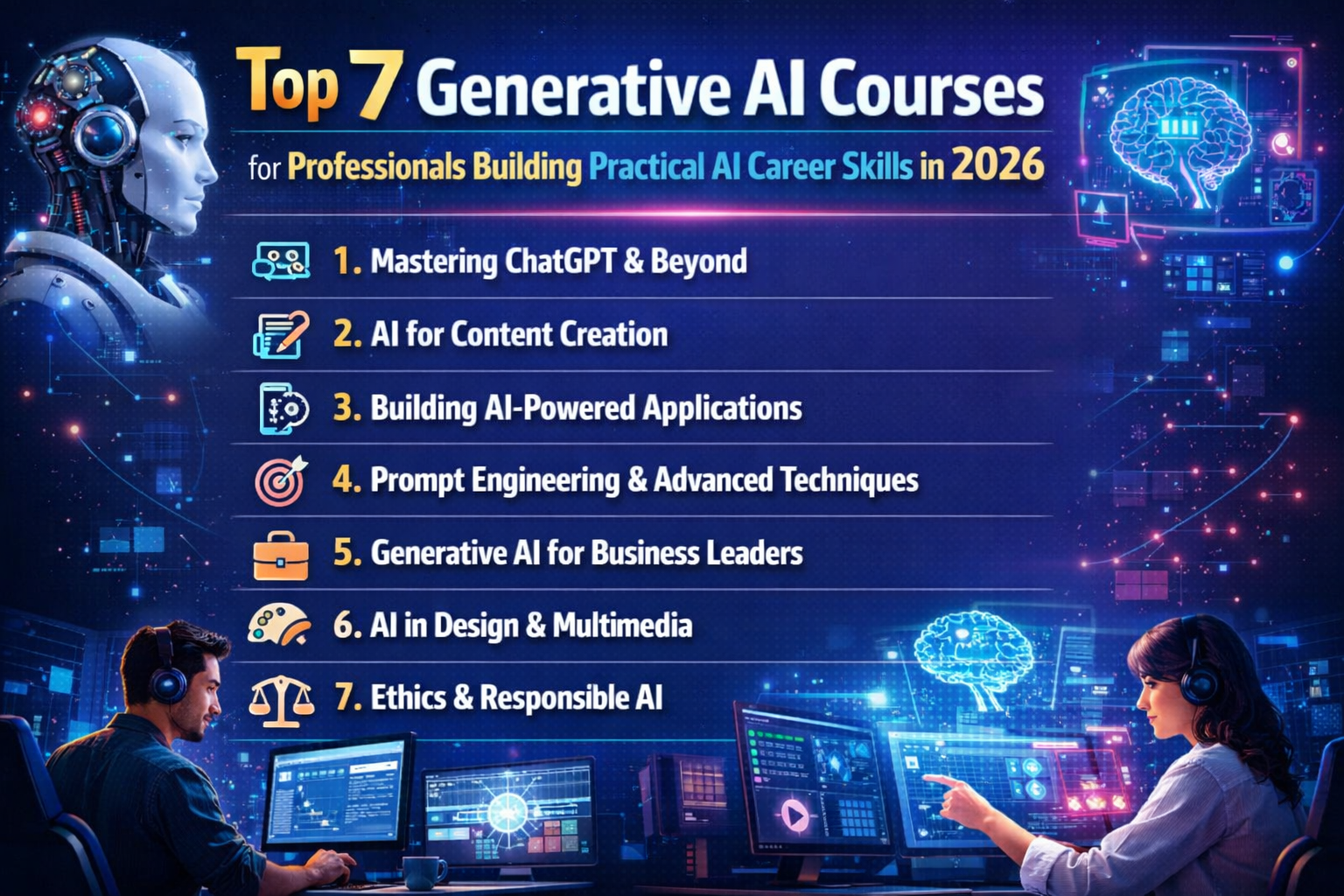
Generative AI is changing how professionals analyze information, create content, automate workflows, and support decisions across business functions. In 2026, strong programs do more than explain tools. They teach practical use, model behavior, governance, generative agents, and implementation in real settings.
This list reviews seven courses for working professionals who want credible certificates and practical value. It includes business-focused and technical options selected for curriculum quality, delivery format, and clear career relevance.
Factors to Consider Before Choosing a Generative AI Course
- Look for a curriculum that covers foundations, prompt engineering, use cases, governance, and applied workflows.
- Check whether the credential is a certificate of completion, CEU-bearing program, or another recognized outcome.
- Choose a format that fits your routine, whether that is live online, self-paced, instructor-led, or blended.
- Match the course to your goal, whether you need business adoption skills, technical depth, or both.
- Review how much hands-on work is included through projects, exercises, case studies, or portfolio tasks.
- Prefer programs that clearly state duration, learner support, and expected professional fit.
Top Generative AI Courses to Strengthen Career-Ready AI Skills in 2026
1) Post Graduate Program in Generative AI for Business Applications | The McCombs School of Business at The University of Texas at Austin
Duration: 14 weeks
Mode: Online
Short Overview:
This program is built for professionals who want a structured generative AI course training tied to real business use. It combines core concepts, prompt workflows, LLMOps, and flexible coding or no-code tracks with projects and case studies.
The result is a practical path for learners who want applied skills, portfolio work, and a recognized credential.
What Sets It Apart:
It offers a certificate of completion and 4.0 CEUs, includes live mentorship, and gives learners a choice between Python-based and no-code tracks with 3 projects and 20+ case studies.
Curriculum / Modules Provided:
The curriculum covers Generative AI foundations, prompt workflows, Python or no-code tool setup, transformer concepts, LLMs, prompt engineering, retrieval augmented generation, and business-focused project work.
Ideal for:
Working professionals, business and tech leaders, AI enthusiasts, and decision makers who want flexible learning with direct business application.
2) Generative AI Business Sprint | MIT Sloan Executive Education
Duration: 30-day access window
Mode: On-demand online
Short Overview:
This short-format course works for leaders who want a direct, business-centered view of Generative AI without a long-term commitment.
It explains how GenAI works, when organizations should apply it, and where the technology is heading, then connects those ideas to strategy, business planning, and competitive advantage.
What Sets It Apart:
Learners complete a self-directed business sprint, receive a certificate of completion, and can finish approximately six hours of study within a 30-day period.
Curriculum / Modules Provided:
The course is organized around four core questions: what GenAI is, how it works, when a business should apply it, and where the field is heading.
Ideal for:
Technical and non-technical managers, senior leaders, and professionals who want a flexible study tied to business transformation.
3) Generative AI: How to Use It and Why It Matters | Harvard Kennedy School Executive Education
Duration: 6 weeks
Mode: Flexible online with live sessions
Short Overview:
This course is for professionals who want a clear understanding of how Generative AI works and how to use it responsibly in real-world settings.
It is practical rather than overly technical, making it useful for professionals who need prompt engineering, use case judgment, and policy awareness without requiring an engineering background.
What Sets It Apart:
Participants receive a certificate of completion, join live faculty sessions, and can complete the program without a technical background.
Curriculum / Modules Provided:
The curriculum covers how Generative AI works, prompt engineering, use in practice, risks, copyright, future of work, misinformation, and a capstone reflection session.
Ideal for:
Business, technology, government, nonprofit, education, and social-sector professionals who want a broad, responsible-use perspective.
4) Generative and Agentic AI | eCornell
Duration: 3 weeks
Mode: 100% online, instructor-led
Short Overview:
This course is a good fit for professionals seeking a concise yet current introduction to Generative AI and agentic systems.
It emphasizes workplace use, practical tools, and implementation-focused thinking, making it useful for professionals who need fast upskilling without enrolling in a long, technical program.
What Sets It Apart:
Learners earn a Recognition of Achievement and 1.5 CEUs, with content designed to fit busy professional schedules.
Curriculum / Modules Provided:
The course covers large language models, Generative AI, AI agents, automation versus augmentation, business process redesign, and practical work with tools such as ChatGPT, Claude, and Perplexity.
Ideal for:
Professionals who want a short instructor-led course that connects current AI tools to everyday business workflows.
5) Certificate Program in Applied Generative AI | Johns Hopkins University
Duration: 16 weeks
Mode: Flexible online
Short Overview:
This program is designed for professionals who want deeper applied Generative AI training across language models, NLP, RAG, and responsible implementation, making it a strong option for those seeking a Gen AI certification.
It blends theory with practical case studies, tool exposure, and project work, making it a strong choice for learners who want more depth than a short survey course can provide.
What Sets It Apart:
It includes a certificate of completion, 10 CEUs, recorded lectures, mentoring sessions, faculty masterclasses, and personalized learning support.
Curriculum / Modules Provided:
The curriculum includes the Generative AI landscape, Python with Generative AI, NLP, transformers, prompt engineering, content generation, secure and responsible AI, LangChain-based agents, RAG, advanced RAG, and fine-tuning.
Ideal for:
Technology professionals, data professionals, consultants, technical managers, and STEM graduates are seeking advanced online study while working full-time.
6) Generative AI for Business | University of Washington Professional & Continuing Education
Duration: 7 weeks
Mode: Online synchronous, evening schedule
Short Overview:
This course is well-suited for professionals seeking a business-first introduction to Generative AI in a shorter format. It is accessible, practical, and focused on productivity, workflow improvement, and prompt use.
That makes it a sensible option for learners who want immediate workplace relevance without a heavy technical barrier.
What Sets It Apart:
The program is introductory, does not require previous experience, and is approved by the Foster School of Business.
Curriculum / Modules Provided:
It focuses on how Generative AI shapes business problem-solving, prompt engineering, and the use of different AI tools to create content for a range of business needs.
Ideal for:
Professionals who want an approachable evening course with clear business use cases and a manageable weekly commitment.
7) Graduate Certificate in Generative AI and Large Language Models | Carnegie Mellon University
Duration: 12 months
Mode: 100% online with weekly live sessions
Short Overview:
This certificate is aimed at professionals who need rigorous technical depth in Generative AI and large language models.
It is substantially more advanced than short executive courses, with graduate-level study, faculty-led live sessions, and asynchronous work that supports real understanding of model behavior, tools, and implementation.
What Sets It Apart:
Learners complete three graduate-level courses taught by faculty from the School of Computer Science in a program designed specifically for working professionals.
Curriculum / Modules Provided:
The program centers on Generative AI and large language models, supported by live instruction, self-paced assignments, and real-world application work across the year.
Ideal for:
Industry professionals in computer science, data science, and software engineering who want deeper technical specialization and a graduate-level credential.
Conclusion
The best Gen AI courses depend on whether you need business fluency, technical depth, or both. A strong fit should offer usable projects, current tools, and a certificate that supports your next role.
In 2026, employers value applied skills more than surface familiarity. Choose the program that matches your schedule and goals, then turn the coursework into work-ready examples you can explain with confidence.