

Introduction
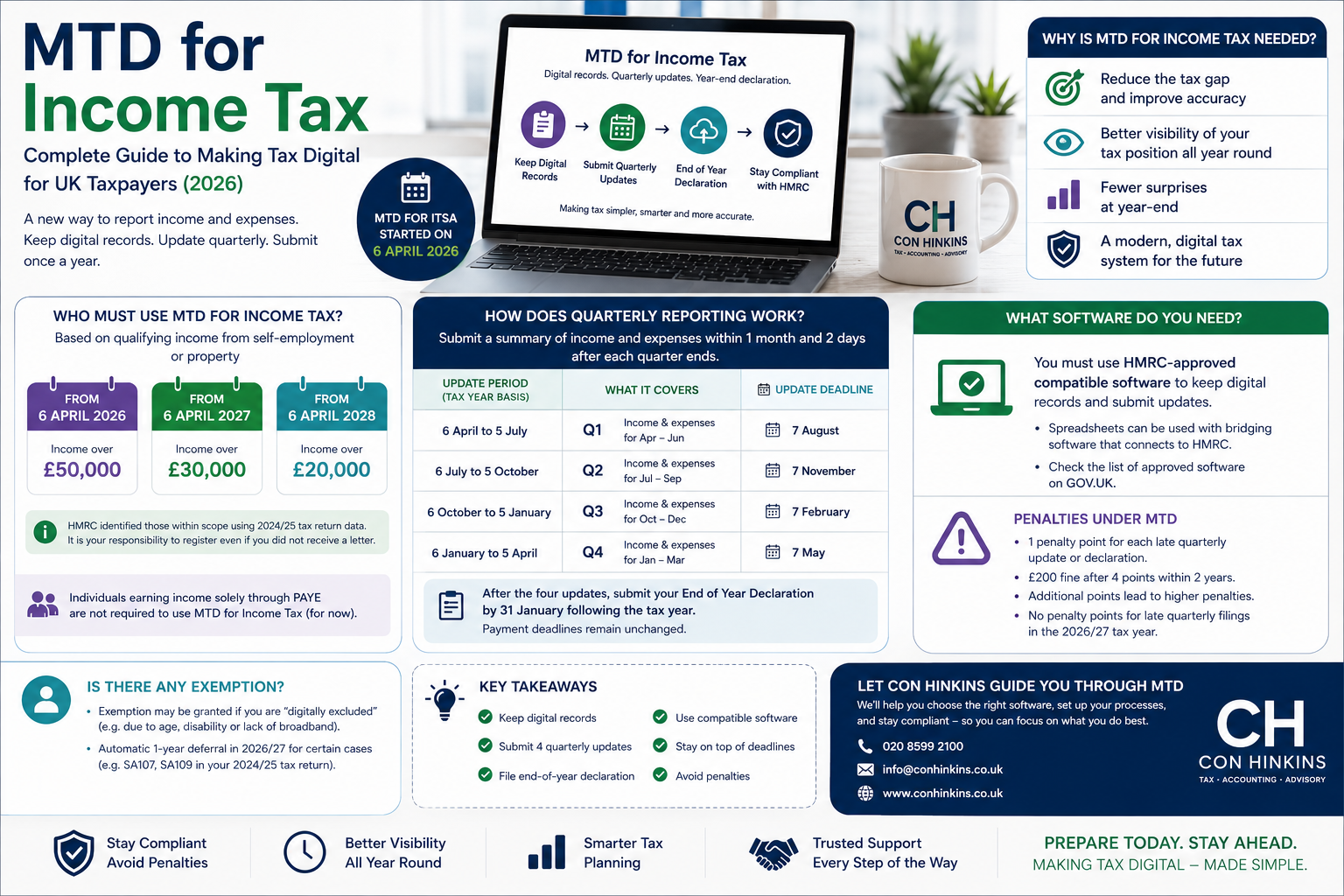
Making Tax Digital for Income Tax (MTD for ITSA) launched on 6 April 2026, bringing a major shift to the UK’s Self-Assessment system. Self-employed individuals, freelancers, and landlords must now keep digital records and submit quarterly updates to HMRC using compatible software, rather than filing just one annual return.
While the change requires adapting to new tools and processes, it aims to improve accuracy and give better visibility of tax obligations throughout the year. Getting familiar with the requirements early will help you stay compliant and avoid penalties.
Why Is MTD for Income Tax Needed?
MTD for Income Tax, officially known as MTD for Income Tax Self-Assessment (MTD for ITSA), refers to HMRC’s efforts to modernise the self-assessment tax return process by moving from paper-based to digital systems. The main difference lies in how taxpayers will be required to file their taxes in the future – rather than filing just once a year,
- Keep track of their incomes and expenses via HMRC-approved software.
- Report quarterly to HMRC throughout the tax year.
- File an end-of-year declaration of their tax situation.
The new scheme draws upon the already implemented MTD for VAT programme.
Who Must Use MTD for Income Tax?
MTD for Income Tax will be rolled out in phases, depending on the level of qualifying income from either sole trading or property:
- From 6 April 2026: Qualifying income over £50,000
- From 6 April 2027: Qualifying income over £30,000
- From 6 April 2028: Qualifying income over £20,000 (announced in the Spring Statement 2025)
HMRC assessed the 2024/25 tax return to identify individuals falling within scope, starting from April 2026. If your qualifying income in that year was more than £50,000, you must have received a letter from HMRC; however, it is still your obligation to register even if you did not receive such a letter.
Those who earn income solely via PAYE are not required to use MTD for Income Tax for now.
Why is HMRC introducing MTD for income Tax?
MTD was implemented by HMRC to modernise the UK’s tax system and to close the “tax gap,” the discrepancy between how much tax should be paid and how much is collected.
The benefits of MTD include lower risk of unpleasant surprises at year-end, greater understanding of current tax obligations, and a more systematic approach to accounting records. HMRC’s own study into the impact of MTD on VAT showed that digital record-keeping led to fewer mistakes, with the vast majority of businesses adjusting well to the new system..
How Does Quarterly Reporting Work?
Under MTD, the tax year is divided into four quarters. Taxpayers must submit a summary of income and expenses for each quarter within one month and two days of the quarter ending. The deadlines are:
| Update period | Update deadline |
|---|---|
| 6 April to 5 July | 7 August |
| 6 April to 5 October | 7 November |
| 6 April to 5 January | 7 February |
| 6 April to 5 April | 7 May |
Alternatively, taxpayers may opt for calendar-year quarters (ending 30 June, 30 September, 31 December, and 31 March), with the same deadlines applying.
After the four quarterly updates, a final end-of-year declaration must be submitted by 31 January following the tax year, the same deadline as the existing Self-Assessment tax return. Payment deadlines remain unchanged, including payments on account and the balancing payment.
What Software do you need?
All record-keeping and submissions under MTD must be carried out using HMRC-approved compatible software. Spreadsheets may be used for record-keeping provided they are linked to bridging software that connects with HMRC’s systems. A list of approved software products is available on GOV.UK.
If you are unsure whether your existing accounting software is compatible, check directly with your software provider before your start date.
Penalties under MTD
MTD introduces a penalty system based on points for filing after the deadline. For each failure to submit the quarterly update or declaration in time, one penalty point is earned. After earning four points within two years, a fine of £200 is imposed. Additional points result in penalties being applied.
Notably, HMRC announced that there would not be any penalty points levied for any quarterly filings that are submitted late in the 2026/27 tax year.
Is There Any Exemption?
Yes, an exemption may be granted by HMRC if a person is “digitally excluded,” which includes individuals who are unable to use digital systems because of their age, disability, or absence of broadband internet connection.
Moreover, there are certain people who are automatically eligible for deferrals for one year during 2026/27, as their tax returns in 2024/25 had complications such as trust and estates income (SA107) and residence and remittance income (SA109).
Conclusion
Making Tax Digital for Income Tax doesn’t have to feel overwhelming. At Con Hinkins, we help you transition smoothly with the right software, clear processes, and ongoing support so you stay compliant without the stress.
Whether you’re already within the £50,000 threshold or preparing for what’s ahead, now is the time to act. Get in touch with Con Hinkins today and let our experts guide you through MTD with confidence, clarity, and complete peace of mind.