

Introduction
For many accounting firms, the Self Assessment season has traditionally been a stressful race against the 31 January deadline. Clients arrive with shoeboxes of receipts, incomplete spreadsheets, and partially filled forms, leaving your team to work late nights to reconcile everything. The result? High stress, rushed checks, and a greater risk of errors.
Since April 2026, clients having qualifying self-employment or property income should bear digital records using HMRC-approved software and provide four updates daily updates during the tax year. This change makes Self Assessment a yearly scramble into a digital, organized working process. For accounting firms, it’s not just about compliance it’s an opportunity to reduce manual work, improve accuracy, and strengthen client relationships.
How Self Assessment Changes under Making Tax Digital
In MTD-ITSA, sole traders and landlords do not need to use paper records at the end of the year or spreadsheets that do not connect with each other. Rather they will have to keep digital records and send quarterly updates which will be directly entered into the final Self Assessment Tax Return.
In the case of accounting companies, this changes the old fashioned once-a-year filing system. You no longer get a stack of statements at the end of the year, but have access to structured, electronic data all year round. The tax regulations are not altered; the only difference is that the way and timing of reporting is going to be changed, and this is where Making Tax Digital Services comes in handy.
Why Making Tax Digital Services Are Making Self Assessment Simple.
Making Tax Digital Services transform the Self Assessment Tax Return into a stressful, one-off task into a streamlined process.
- Centralised records: The income, expenses, receipts are fed into a HMRC-approved software, eliminating the necessity to keep paper, emails, and different spreadsheets.
- Quarterly updates: With every update, it will serve as a review gate enabling you to identify errors, missing income or some suspicious entries early.
- Draft generation: The software can generate a draft return by the end of the tax year, thereby decreasing the number of mistakes in manual entry and transcription.
Such a strategy would result in fewer corrections, less conflict with HMRC and a less stressful experience by clients who would now start to consider tax compliance as a process to manage instead of a year-end panic.
Integrating Making Tax Digital Services into Your Firm
For maximum advantage, MTD Services must be integrated into your business as follows:
- Use standardized software: Use HMRC approved and MTD compliant software for all your small business and landlord clients.
- Client training: Ensure that your clients understand how to keep records and make regular uploads.
- Regular review: Take advantage of every update to review coding, highlight any anomalies, and engage in discussions about tax planning.
- Return processing: Instead of being involved in the data input process, you will validate and optimize your returns.
Through integrating MTD Services into your firm, your employees will become more proactive, thereby upgrading the service from a compliance issue to advisory.
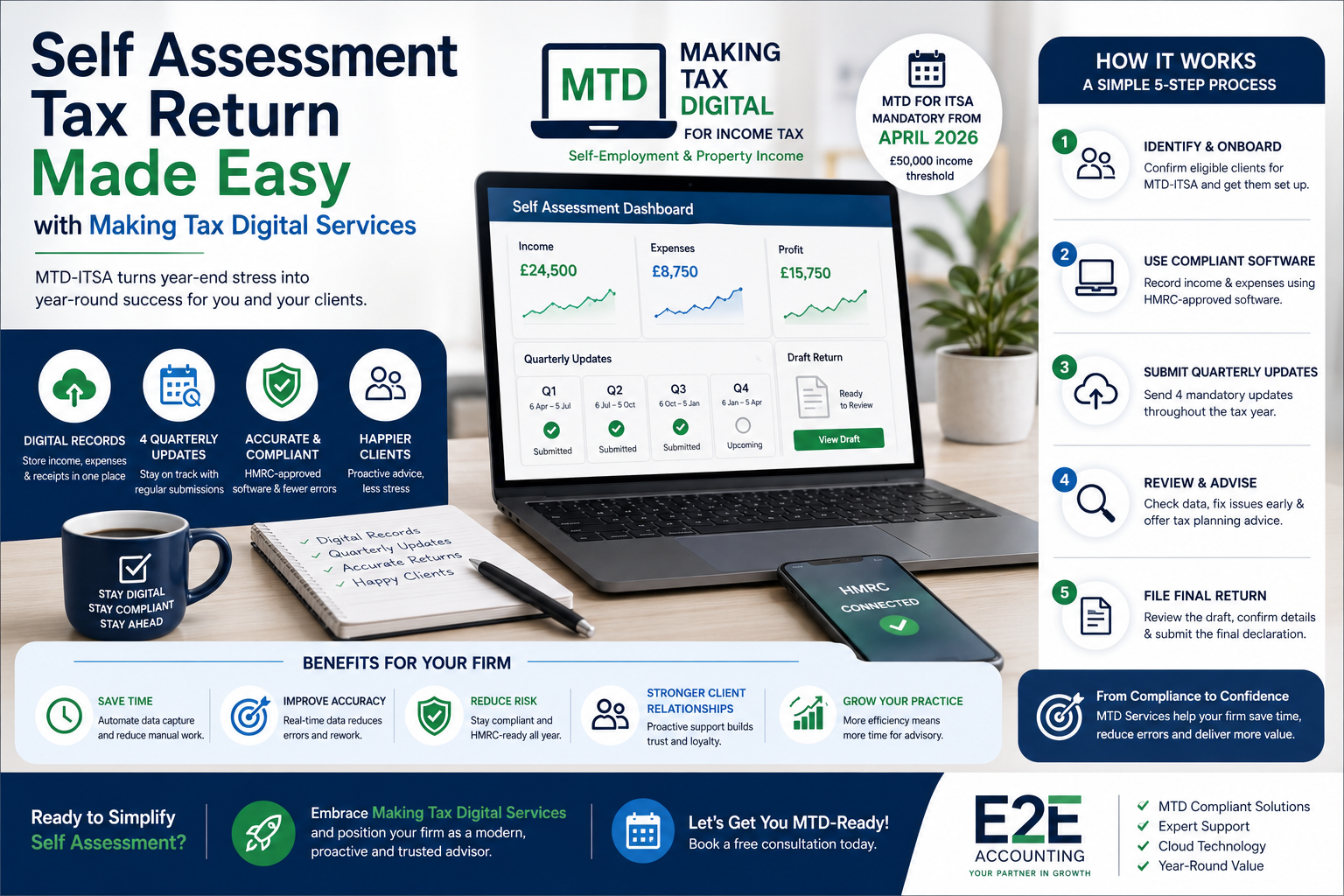
Streamlining Self Assessment Process Easily
Identify eligible customers: Confirm which clients fall under MTD-ITSA (sole traders and landlords above HMRC thresholds £50,000 gross income from April 2026, then £30,000 and £20,000 in later years). Check whether each client is enrolled for MTD for Income Tax and flagged by HMRC, so onboarding can be prioritised efficiently.
Make your software compliant: HMRC-recognised software that can keep digital records, submit the four required quarterly updates, and generate a final Self Assessment-style declaration. By centralising all client data in one platform, this approach eliminates manual re-entry, reduces errors, and ensures your workflow remains efficient and audit-ready throughout the year.
Link client to HMRC: Ensure clients have Government Gateway accounts and authorise your firm as an agent, so software can send updates and submit returns on their behalf. Proper linking prevents last-minute issues with HMRC submissions.
Use quarterly updates for evaluation: After each quarterly update, check income and expense coding, reconcile totals, and review unusual transactions. These updates also provide a chance to advise clients on cash flow, profitability, and simple tax planning.
File the final return: At year-end, review the software-generated draft, confirm allowances and adjustments, and submit the final declaration. This reduces errors, improves audit quality, and ensures returns reflect accurate records and professional judgment.
Following these steps transforms Self Assessment into a structured, value-driven service that clients trust year-round.
Conclusion
MTD Services are transforming the landscape of Self Assessment services for sole traders and landlords. Gone are the days when tax accountants scrambled to gather necessary documents at the last minute.
The advantages are apparent: better working papers, minimized mistakes, and enhanced client experiences. As an accounting firm, Making Tax Digital Services help you save time, increase precision, and engage in valuable consultations about tax planning and financial flows.
What’s next? Embrace MTD Services, adopt the right software, and market your firm as the innovative and technology-driven entity that can provide clients with year-round services.