

By Drake Miller – Senior Content Manager and Academic Strategy Consultant
For many Australian students, the “Holy Trinity” of life consists of coffee, a looming Turnitin deadline, and a live stream of the Wallabies, the Matildas, or the AFL. In a sports-mad nation where time zones often force us to choose between a 3:00 AM Champions League kickoff and a 9:00 AM lecture, the struggle is real.
Australia’s unique sporting culture—spanning from the NRL and AFL to global icons like Formula 1 and the NBA—creates a digital tug-of-war. How do you maintain a High Distinction average when the “game of the century” is happening right in the middle of your study session? This guide explores the art of the “student-athlete-spectator” balance, offering a strategic playbook for high school and university students to manage their screens without sacrificing their GPAs.
The Digital Dilemma: Why the Struggle is Unique to Australia
In Australia, sports aren’t just entertainment; they are a social currency. Missing the State of Origin or a crucial Cricket World Cup match means being left out of the group chat and the Monday morning campus banter. However, the rise of platforms like VIPLeague has made sports more accessible than ever, meaning the temptation to “just watch one quarter” is always just a tab away.
The problem? Cognitive load. Research shows that ‘multitasking’ (watching a game while writing an essay) reduces productivity by up to 40%. For those tackling high-precision subjects, seeking professional accounting assignment help can be a strategic move to ensure your balance sheet remains accurate while you focus on the scoreboard..
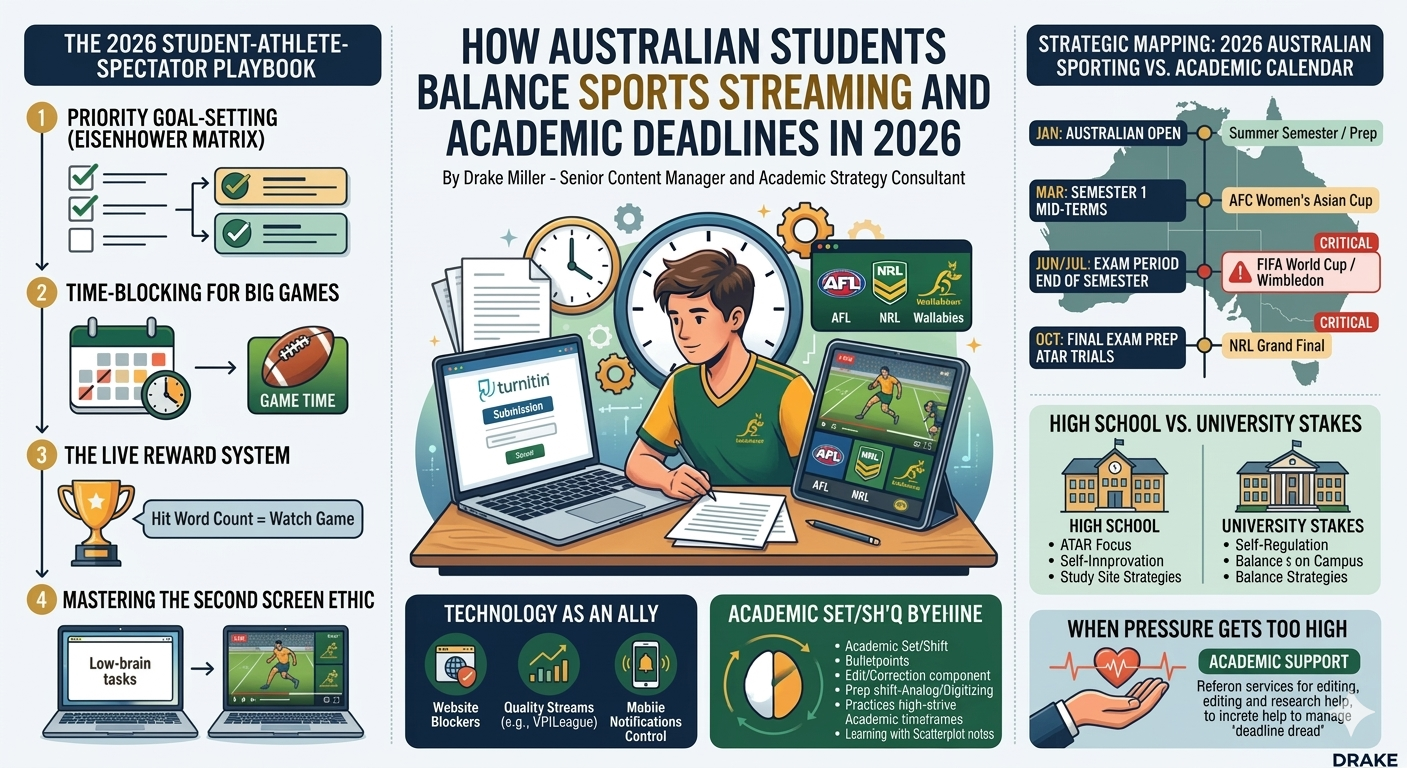
Strategic Mapping: The 2026 Australian Sporting vs. Academic Calendar
To win the academic premiership, you must anticipate the “collision points” where major sporting events hit peak assessment periods. Here is how the 2026 calendar looks for an Australian student:
|
Month |
Major Sporting Event |
Academic Milestone |
Risk Level |
|
January |
Australian Open (Melbourne) |
Summer Semester / Prep |
Low |
|
March |
AFC Women’s Asian Cup |
Semester 1 Mid-terms |
High |
|
May |
NRL Magic Round / State of Origin I |
Mid-year Assignments |
Critical |
|
June/July |
FIFA World Cup / Wimbledon |
Exam Period / End of Semester |
Critical |
|
September |
AFL & NRL Finals Series |
Semester 2 Peak Workload |
High |
|
October |
Bathurst 1000 / NRL Grand Final |
Final Exam Prep / ATAR Trials |
Critical |
|
Nov/Dec |
The Ashes (Men’s & Women’s) |
Final Exams / Summer Break |
Medium |
The Strategy: Winning the Academic Premiership
If you want to stay on top of your game, you need a system. You can’t rely on willpower alone—especially when the siren is about to go off.
1. The “Priority Goal-Setting” Method
Before you open a streaming tab, you need to clear your academic “defensive line.” When the workload becomes unmanageable during the finals season, many students seek online assignment help Brisbane to ensure their grades don’t slip while they support their team. Use the Eisenhower Matrix to categorize your tasks:
-
Urgent & Important: That assignment is due in 12 hours. (No sports allowed).
-
Not Urgent & Important: Researching for next week. (Sports allowed in the background).
-
Urgent & Not Important: Checking social media scores. (Delegate to halftime).
2. Time-Blocking for the Big Games
If you know the Australian Open final is on Sunday night, don’t leave your bibliography for Sunday night. High-achieving students treat sports like a scheduled appointment.
-
The Pre-Game Sprint: Work intensely for three hours before the match starts.
-
The Live Reward: Use the game as a reward for hitting a word-count milestone. If you hit 1,000 words, you get to watch the second half guilt-free.
3. Mastering the “Second Screen” Ethic
We all do it, but there is a right way to use a second screen. If you are doing “low-brain” tasks—like formatting a reference list or organizing folders—having a stream on in the corner of your laptop is fine. However, if you are drafting a thesis statement or solving complex calculus, the stream must go off.
When the Pressure Gets Too High: Outsourcing the Work
Let’s be honest: sometimes, the schedule is impossible. You might have three finals in one week, a part-time job, and a once-in-a-lifetime sporting event you simply cannot miss. In these moments, the smartest move isn’t to fail; it’s to seek support.
For many Australian students, professional academic support acts as the “coach” in the corner. Whether it’s getting a head start on research, checking for plagiarism, or getting professional editing on a complex paper, utilizing services like Myassignmenthelp.services allows you to reclaim your time. By offloading the heavy lifting of structural editing or data gathering to experts, you ensure that your academic deadlines are met with professional quality, leaving you the mental space to enjoy your favorite sports without the “deadline dread.”
High School vs. University: Different Stakes
For High School Students (Years 10-12)
The ATAR pressure is immense. At this level, sports should be your break, not your background noise. Physical activity—actually playing the sport—is also vital for cognitive function. If you’ve spent all day streaming the NBA, make sure you spend 30 minutes shooting hoops outside to clear your head before tackling your ATAR English homework.
For University and Post-Grad Students
Self-regulation is the name of the game. With fewer contact hours, it’s easy to fall into a cycle of “revenge bedtime procrastination.” Use a digital planner to sync your assessment dates with the sporting calendar. If the Ashes are in England (meaning late nights for Aussies), adjust your sleep schedule a week in advance.
Technology as an Ally, Not an Enemy
-
Website Blockers: Use Chrome extensions to block sports news sites during “deep work” hours.
-
Quality Streams: Using reliable platforms like VIPLeague ensures you don’t waste time dealing with broken links. If you’re going to watch, watch efficiently so you can get back to work.
-
Mobile Notifications: Set your phone to “Do Not Disturb” but allow “Time Sensitive” notifications for score updates.
The Social Aspect: Group Study vs. Group Watching
One of the best parts of being a student in Sydney, Melbourne, or Brisbane is the pub and campus culture surrounding sports. However, the “study group” that turns into a “watching the footy group” is a classic trap. Set a hard boundary: “We study from 4 PM to 7 PM, then we head to the common room for the 7:30 PM kickoff.”
Frequently Asked Questions
Q.1 Is it okay to watch sports while I study?
Only for passive tasks. If the task requires creative writing or complex problem solving, the “split attention effect” will significantly lower your grade. Use the stream as a reward for finishing a section instead.
Q.2 How do I handle 3:00 AM international games?
This is the biggest risk to your GPA. If you must stay up, ensure you have completed all academic work for the following day before the game starts, as your “post-game brain” will not be fit for study.
Q.3 What should I do if a major final overlaps with a deadline?
Plan two weeks in advance. If you cannot get ahead of the workload, seek academic support online to handle the technical aspects of your paper so you can focus on your exams and the game.
Conclusion
Balancing a love for sports with the rigors of Australian academia is about integration and discipline. The skills you learn while managing these conflicting interests—time management, prioritization, and resilience—are the exact skills that will make you successful in your future career. Enjoy the game, celebrate the wins, but always keep your eyes on the ultimate prize: your degree. And if the pressure ever gets to be too much, don’t be afraid to call for a “substitution” and get the academic help you need to stay in the game.
About the Author:
Drake Miller is a senior content manager and academic strategy consultant with over 12 years of experience in higher education and digital strategy. Based in London and Sydney, Drake specializes in helping students navigate the intersection of digital literacy and academic success.