

Introduction
In the final sprint of hardware innovation, teams are often trapped by a false “either-or” choice. They select 3D printing for “speed” but sacrifice part strength, causing functional tests to fail. They choose CNC machining for “strength” but are bogged down by long lead times and high per-unit costs, slowing the entire iteration cycle. This binary dilemma leads to wasted development budgets on prototypes that do not align with final production goals.
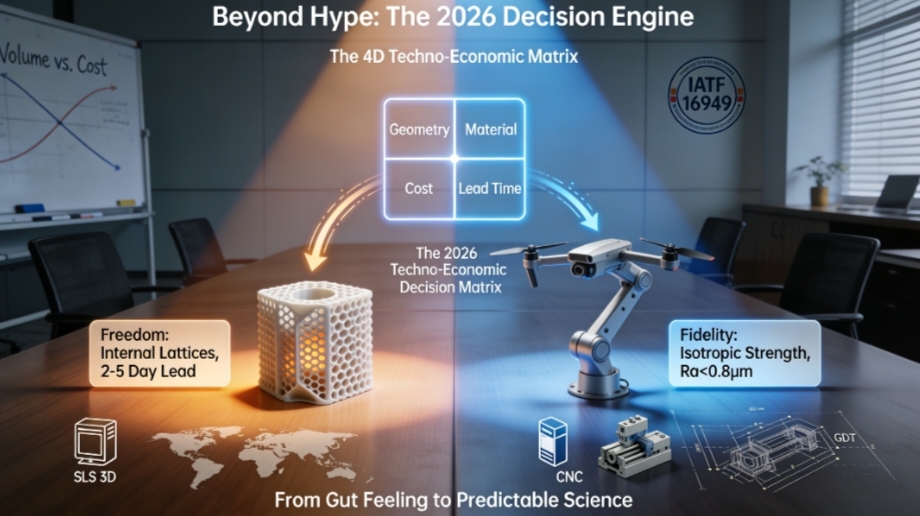
The root cause is that decisions are often based on superficial stereotypes of the two technologies, not on a deep understanding of how the underlying physics of “subtractive” and “additive” processes determine a part’s “performance DNA.” The lack of a quantitative framework to weigh the dynamic relationships between “geometric freedom,” “material fidelity,” “economic batch thresholds,” and “delivery speed” leads to blind selection. This article provides a “Techno-Economic Four-Dimensional Decision Matrix” to transform prototyping into a predictable engineering science.
Subtractive vs. Additive: How Do Fundamental Physics Lock in Performance Ceilings?
The decision matrix starts by piercing through marketing terms to examine the fundamental “physical genes” of each process. CNC machining is a subtractive process, removing material from a solid block. This method produces parts that inherit the dense, isotropic microstructure of the parent material, forming the foundation of functional fidelity and predictable mechanical performance. In contrast, 3D printing is an additive process, building parts layer by layer. This introduces variables like interlayer bond strength, microscopic porosity, and anisotropic properties that can impact performance, especially under stress or in harsh environments.
1. The Material Science Foundation of Performance
The subtractive nature of CNC ensures the final part’s properties are those of the certified, wrought material stock. This is critical for applications where fatigue life, thermal conductivity, or chemical resistance are non-negotiable. The additive process, while revolutionary, creates a newmaterial structure whose properties can be influenced by print orientation, energy source, and post-processing. Understanding this core difference, as outlined in comparative resources from authorities like the Society of Manufacturing Engineers (SME), is the first step to a rational choice.
2. Predictability Versus Potential
CNC offers predictability; 3D printing offers potential. For a functional prototype that must behave like the eventual injection-molded or machined production part, CNC’s material consistency is paramount. For exploring shapes impossible to make any other way, 3D printing’s unprecedented geometric freedom is the key. The choice hinges on which attribute — proven performance or radical form — is the higher priority for the current stage of development.
3. The Path to CNC’s Deterministic Performance
Achieving this performance certainty with CNC is a disciplined engineering process. It involves precise toolpath generation, optimal cutting parameters, and controlled environments. To fully grasp how subtractive manufacturing achieves this through meticulous machining of a material substrate, a comprehensive resource is invaluable. A deep-dive guide on CNC rapid prototyping services details the complete value chain, from programming to post-processing.
Where is the True “Cost Crossover”? Modeling Beyond the Unit Price Tag
A per-part quote is deceptive. The true economic analysis requires a Total Cost of Ownership model for the prototyping phase. This model must include amortized machine/programming time, material cost and utilization, mandatory post-processing labor, and the expected cost of quality (scrap, rework, delayed testing). A simplistic price comparison fails to find the real breakeven point.
- Building a Dynamic Cost Model: Consider a mid-complexity component like a drone arm. For the first 1-5 pieces, 3D printing’s near-zero setup cost and high material utilization often make it the cost leader. In the 5-50 piece range, the curves can intersect, as CNC’s higher upfront programming/setup cost is offset by its lower variable cost per part. Beyond 50 units, CNC’s scaling efficiency typically makes it the definitive economic choice. This reveals the dynamic nature of prototyping economics.
- The Hidden Costs of “Free” Complexity: 3D printing’s ability to make complex geometry at no extra cost is a double-edged sword. It can lead to designs that are inherently difficult, expensive, or impossible to mass-produce, creating a costly redesign later. CNC’s manufacturing constraints encourage Design for Manufacturability thinking from the start, which can prevent downstream production headaches. This strategic cost avoidance must be part of the long-term financial analysis.
- From Model to Strategic Insight: Therefore, the “best” process is a function of volume, complexity, and project phase. Building this model forces teams to quantify their needs, moving beyond gut feel. It provides a data-driven framework for choosing the most cost-effective path, not just for a single order, but for the entire development workflow, leading to smarter business solutions.
The Geometry Trap: When Does “Unlimited Complexity” Become a Manufacturing Liability?
“Design freedom” is not an unalloyed good; it must be evaluated against the realities of function and production. 3D printing holds an absolute advantage for internal features like conformal cooling channels, lightweight lattice structures, and single-piece assemblies that would be impossible to assemble. This enables thermal and structural optimizations unreachable by traditional means.
1. The CNC Counterpoint: Precision and Surface Integrity
Conversely, CNC machining has a natural advantage in achieving exceptional precision and surface quality. It can reliably produce mirror finishes (Ra < 0.8μm), true cylindrical bores, and perpendicular faces critical for sealing, bearing fits, and optical components. For a medical device housing that must mate perfectly with other components, a 3D-printed surface often requires significant post-processing to meet the same standard.
2. Designing for the Intended Manufacturing Process
The key is to design for the intendedfinal manufacturing process, even at the prototype stage. A part optimized for 3D printing may be unmanufacturable or prohibitively expensive in production via CNC or molding. This disconnect can invalidate prototype testing. A disciplined Rapid prototyping technology comparison asks: “Are we prototyping the final design, or a design that can only exist as a prototype?”
3. Choosing the Right Tool for the Right Feature
A sophisticated approach uses each technology for its strengths. Use 3D printing to validate ergonomics, internal architecture, and assembly fit. Use CNC to create prototypes of high-stress components, wear surfaces, and parts that will be CNC’d in production. This hybrid mindset moves beyond the “CNC or 3D printing for prototyping” debate to a more nuanced innovation guide.
Case Dissection: The Robotic Arm That Chose Both – A Hybrid Strategy in Action
The most powerful insight is that the optimal path is often a strategic blend of both technologies. Consider a case involving a robotic arm joint. The client faced a dilemma: the design required a complex internal sensor cavity best made by 3D printing, but the final part needed the strength and wear resistance of machined aluminum for functional testing. A single-technology approach forced a compromise.
1. Implementing a Phased Hybrid Strategy
The implemented solution was a phased, hybrid strategy. In the initial form-and-fit phase, Selective Laser Sintering (SLS) 3D printing was used to produce multiple design iterations of the housing in just days, allowing rapid validation of the internal sensor layout and overall assembly. Once the design was frozen, CNC machining was used to manufacture the final functional test units from 6061 aluminum, providing true material performance.
2. Quantifying the Hybrid Advantage
The results were transformative. By avoiding the high cost and lead time of machining every early iteration, and by avoiding the performance limitations of a 3D-printed final test part, the team shortened total development time by 50% and reduced overall prototype spending by 30%. This case exemplifies Process Analysis at its best, where the process itself is designed to meet project objectives.
3. The Integration Behind the Strategy
Successfully executing a hybrid strategy requires more than just access to both machines. It demands a unified project management and quality philosophy to ensure data and learnings flow seamlessly from the 3D-printed prototype to the CNC-machined part. Therefore, turning a scientifically derived optimal plan into a delivered, high-quality prototype depends on a partner with integrated capabilities. A rapid prototyping CNC machining supplier with deep multi-technology platform integration is essential to execute such hybrid strategies reliably.
The 2025 Trend Lens: Sustainability and Digital Thread – How Do They Reshape the Choice?
The decision matrix must be viewed through the lens of 2025’s dominant trends: Sustainability and the Digital Thread. These forces are actively recalibrating the value proposition of each technology. From a sustainability standpoint, consider material utilization, energy consumption per part, and end-of-life recyclability. CNC generates waste (chips) that is typically clean and easily recycled; some 3D printing processes use support structures that become waste and may use polymers that are harder to recycle.
- The Digital Thread and Manufacturing Data: The Digital Thread — the seamless flow of data from design to production — favors processes that generate reliable manufacturing data. A CNC toolpath is a precise, digital recipe that can be directly transferred to production. In-process monitoring data from CNC (vibration, tool wear) builds a knowledge base for production. For 3D printing, establishing an equally robust digital process signature for quality prediction is an active area of development but can be more complex.
- Strategic Alignment with Future Systems: Frameworks like IATF 16949 (quality) and ISO 14001 (environmental management) systematically influence process selection. They mandate evaluating material flow, energy use, and knowledge continuity from prototype to production. A choice that aligns with these systems supports not just a single project, but the organization’s long-term goals for responsible and traceable manufacturing, a key industry trend.
- Future-Proofing Your Prototyping Strategy: When choosing a prototyping technology today, consider its trajectory. How will it integrate with your factory’s evolving smart systems and sustainability metrics? Selecting a partner and a process that are investing in and aligning with these broader business solutions ensures your prototyping approach remains viable and valuable as the manufacturing landscape evolves.
Conclusion
In the accelerating race of hardware innovation, the choice between CNC and 3D printing for rapid prototyping is far from a simple technical selection. It is a systems decision engineering challenge that demands synthesis of materials science, dynamic economics, design philosophy, and strategic foresight. By adopting a decision matrix grounded in four-dimensional techno-economic analysis, teams can cut through the hype and transform process selection from a reactive cost center into an active lever that drives innovation efficiency, controls project risk, and builds core competency for the future of making. This is not just about picking a tool; it is about embedding a rational, data-driven DNA into the organization’s innovation process.
FAQs
Q: For a high-temperature application (e.g., >150°C), which technology is inherently more reliable?
A: CNC is typically more reliable for consistent high-temperature performance. It machines parts from solid blocks of engineering-grade materials, inheriting their bulk isotropic properties. 3D-printed parts can have layer adhesion and porosity issues that may reduce strength and creep resistance under prolonged thermal stress, making them less predictable.
Q: If my design is still changing weekly, which method makes more financial sense?
A: In the early, volatile concept phase, 3D printing is almost always more cost-effective, as changes only require a digital file update with no tooling to redo. Once the design stabilizes and you need parts for functional testing that mimic production intent, switching to CNC for its material and performance fidelity optimizes total cost.
Q: Can CNC machining produce the same lightweight, organic lattice structures as 3D printing?
A: Generally, no. CNC tools cannot physically access and machine enclosed, complex internal lattices in a single piece — this is a core strength of 3D printing. CNC excels at machining pockets, ribs, and thin walls. For parts needing both complex internals and high-performance surfaces, a hybrid approach (3D-printed core, CNC-machined interfaces) is often optimal.
Q: How do lead times typically compare for 1-5 pieces of a medium-complexity part?
A: For 1-5 pieces, 3D printing often has a shorter lead time (2-5 days) due to minimal setup. CNC involves programming and setup, leading to 3-7 day lead times. However, for parts requiring exceptional surface finish or tight tolerances directly from the machine, CNC’s “finished-part” lead time can be comparable when factoring in 3D printing’s post-processing.
Q: Is the advice provided by the supplier objective, or are they merely pushing the specific technologies they happen to possess?
A: One of the core strengths of a full-service provider lies in their ability to offer objective advice. Leveraging advanced CNC machining facilities and industrial-grade 3D printing equipment, the recommendations they provide are based entirely on the specific requirements of your project — encompassing aspects such as performance, cost, and lead time — rather than simply aiming to maximize equipment utilization.
Author Bio
This article originates from deep, quantitative practice in analyzing and optimizing rapid prototyping technology pathways while serving global innovation projects. The insights translate the challenge of technology selection into a structured, evidence-based discipline. LS Manufacturing is a certified manufacturing partner dedicated to empowering clients with the decision-making capability to scientifically select and optimize their development and prototyping processes.