

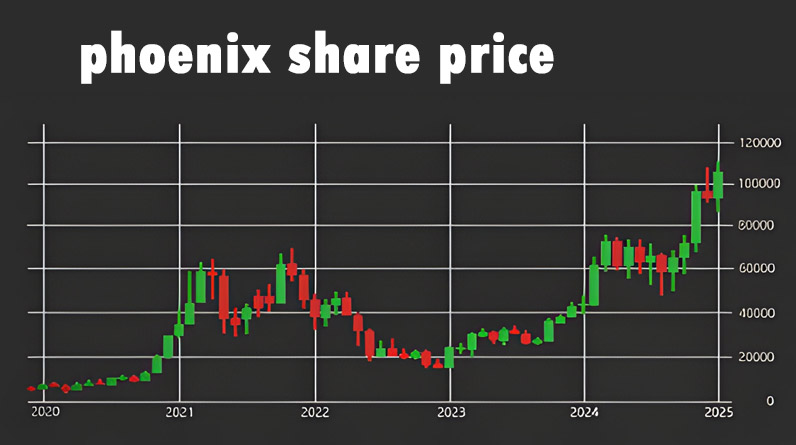
When investors think about successful stock picks, they typically envision rising share prices, capital appreciation, and impressive growth trajectories. However, Phoenix Group Holdings (LSE: PHNX) represents a refreshingly different investment paradigm—one that rewards patience, discipline, and a focus on cash flow over capital gains. With the Phoenix share price trading relatively flat over the past five years while delivering one of the FTSE 100’s highest dividend yields at 8.3%, this insurer offers a compelling case study in why conventional metrics don’t tell the whole investment story.
Understanding Phoenix requires abandoning traditional growth-focused thinking and embracing an income-compounding philosophy that builds genuine wealth over decades rather than months.
The Phoenix Share Price Paradox: Flat Performance, Remarkable Returns
At first glance, Phoenix’s share price performance appears underwhelming. Trading at 677 GBX as of October 2025, the stock has delivered minimal capital appreciation over the past five years. For investors accustomed to technology stocks and growth-focused portfolios, this stagnation might feel disappointing.
However, this perspective misses the fundamental story that Phoenix tells about modern income investing. The real performance lies not in the share price movement, but in the dividends consistently returned to shareholders—a distinction that separates wealthy, patient investors from those perpetually chasing short-term gains.
Key Phoenix Share Price Statistics
| Metric | Value |
| Current Share Price | 677 GBX |
| Dividend Yield | 8.3% |
| 52-Week High | 699.50 GBX |
| 52-Week Low | 475.20 GBX |
| Market Capitalisation | £6.82 billion |
| Quarterly Dividend | 13.68 GBX |
| 10-Year DPS Growth Rate | 3.2% CAGR |
The Dividend Story: Building Wealth Through Compounding
Phoenix’s real value proposition emerges when examining its dividend trajectory and the power of compounding. Over the past decade, the company has grown its dividends per share at a compound annual growth rate of 3.2%—a modest but remarkably consistent figure that compounds into significant wealth over extended holding periods.
This consistency matters more than many investors realize. Consider a practical example: a £5,000 initial investment in Phoenix shares, with dividends reinvested annually and assuming a conservative 3% annual dividend increase over 15 years, generates exponential growth that far exceeds the linear returns achieved by simply withdrawing cash annually.
Compounding in Action: A 15-Year Scenario
Imagine two investors, both holding £5,000 in Phoenix shares:
- Investor A reinvests all dividends, leveraging compounding to purchase additional income-generating shares
- Investor B withdraws dividends as cash income
Over 15 years, assuming a flat share price and 3% annual dividend growth, Investor A’s portfolio grows exponentially, creating an income stream that increasingly diverges from Investor B’s static dividend. The difference isn’t marginal—it’s transformational, particularly as the investor approaches retirement and desires sustainable passive income without capital depletion.
This principle explains why Phoenix attracts serious income investors who understand that wealth building isn’t always about flashy capital appreciation, but about disciplined, compounding cash generation.
Understanding Phoenix’s Financial Foundation
Beneath the dividend story lies a company with genuinely robust financial health—a prerequisite for any dividend stock claiming sustainability.
Operating Capital Generation: The Dividend Safety Net
Phoenix generated £705 million in Operating Capital Generation (OCG) during H1 2025, of which only £274 million was distributed as dividends. This crucial metric reveals the dividend’s safety margin: the company pays out less than 39% of its operating capital, leaving substantial headroom for reinvestment and potential dividend increases during challenging periods.
This ratio matters enormously. Companies paying out 80-100% of earnings face difficulty raising dividends during market downturns or operational challenges. Phoenix’s conservative payout ratio provides genuine protection for shareholders seeking reliable income.
Solvency Coverage Ratio and Balance Sheet Strength
Phoenix maintains a solvency coverage ratio of 175%, positioning it in the upper half of its operating range. For insurance companies, this metric indicates the ability to absorb financial shocks, manage risks, and maintain regulatory compliance without jeopardizing operations.
Additionally, distributable reserves reached £5.5 billion—a 20% year-on-year increase that further demonstrates capital accumulation and financial strengthening, not depletion.
The Accounting Complexity: Decoding Phoenix’s Financial Statements

Phoenix’s H1 2025 results highlighted an accounting complexity that deserves careful examination. Shareholders’ equity under IFRS (International Financial Reporting Standards) fell 37% to £768 million, seemingly alarming. However, on an adjusted basis using the Solvency II framework, shareholders’ equity stood at £3.5 billion—a massive discrepancy requiring explanation.
Why the Gap Exists: IFRS vs. Solvency II
The explanation lies in fundamental valuation methodology differences:
| Framework | Approach |
| IFRS | Values long-term investment contracts (annuities) using fixed economic assumptions |
| Solvency II | Re-values contracts each reporting period to reflect current market conditions |
This creates a valuation “mismatch.” Rising interest rates benefit annuity valuations under Solvency II (improving equity), while IFRS valuations remain anchored to historical economic assumptions, creating apparent deterioration. The phenomenon represents accounting mechanics rather than fundamental business deterioration, yet it warrants monitoring—if IFRS equity fails to recover, investor confidence could erode despite underlying operational health.
Phoenix Share Price Outlook: Analyst Consensus and Future Prospects
Wall Street consensus on Phoenix reveals interesting nuance. Twelve analysts covering the stock maintain a median 12-month price target of 705 GBX, suggesting limited upside from current levels. However, the target range spans 880 GBX at the bullish end, indicating meaningful disagreement among experts about future direction.
This analyst uncertainty reflects Phoenix’s genuine nature: a company excelling at income generation and capital preservation, but offering limited capital appreciation catalysts. For growth-focused investors, this represents disappointment. For income-focused investors, it’s largely irrelevant—the dividend matters infinitely more than share price movement.
Is Phoenix Share Price Movement Relevant to Income Investors?
Here lies a critical insight: for investors focused on passive income and compounding, share price volatility is a feature, not a bug. Market downturns create buying opportunities to accumulate additional shares at discounted valuations, accelerating compounding without requiring additional capital.
Consider the 52-week trading range of 475.20 to 699.50 GBX. An income investor purchasing shares during the low end captures dividends on positions acquired at 30% discounts, meaningfully improving long-term returns without requiring increased investment.
Key Advantages for Income-Focused Investors
- Yield Stability: 8.3% yield remains among FTSE 100’s highest
- Dividend Sustainability: Conservative payout ratios protect against dividend cuts
- Growth Trajectory: 3.2% CAGR dividend growth compounds significantly over decades
- Capital Generation: £705m OCG provides reinvestment flexibility
- Regulatory Strength: 175% solvency ratio demonstrates risk management
Potential Concerns and Considerations
Despite compelling income characteristics, Phoenix presents legitimate considerations:
- IFRS Equity Deterioration: Continued equity decline under IFRS accounting could raise long-term sustainability questions
- Interest Rate Sensitivity: As an insurer, Phoenix faces valuation impacts from interest rate changes
- Capital Appreciation Limitations: Patient investors must accept minimal share price growth
- Regulatory Environment: Insurance company operations face ongoing regulatory scrutiny and potential changes
Conclusion: A Different Investment Approach
Phoenix Group Holdings represents a fundamentally different investment approach than contemporary stock market enthusiasm often celebrates. The flat share price that might discourage conventional investors actually represents the foundation of a powerful income-compounding machine—one that quietly builds substantial wealth for disciplined, patient investors focused on cash generation rather than capital appreciation.
For those seeking reliable passive income, a growing dividend stream, and financial stability supported by robust capital generation and reserves, Phoenix deserves serious consideration. The insurer’s “boring” dividend story, combined with financial strength, creates genuine wealth-building potential that extends across decades.
In an investment world obsessed with growth, Phoenix reminds us that sometimes the most powerful returns come not from excitement, but from boring, consistent, compounding income—a philosophy that has enriched patient investors throughout market history.